What’s Your Carbon Footprint and Why Does it Matter?
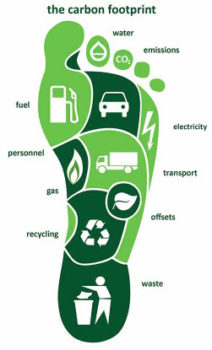
Your carbon footprint is your total output of greenhouse gas emissions (GHGs). When we drive and travel, when we heat our homes with oil or gas (or with electricity generated by fossil fuels such as coal, oil, and gas), and even when we purchase goods that are farmed, manufactured or shipped, GHGs (predominately CO2) are emitted.
GHGs have increased steadily since the preindustrial era, due almost entirely to human activity. As atmospheric CO2 rises, it causes more heat to be trapped in the atmosphere (“greenhouse effect”), raising global temperatures, which fuels climate change. Scientists predict that rising global temperature will produce more frequent extreme weather events (e.g., heat waves, hurricanes).
There are many online calculators to help you estimate your carbon footprint and learn how to reduce it. They vary in the areas they address, their level of detail and assumptions. Some emphasize household energy and auto transportation, while others include diet, air travel and shopping habits. Thus, you will likely see differences in total carbon footprints, but compare your results to the average results.
How Can You Visualize the Impact and Magnitude of Carbon Dioxide (CO2) Emissions?
The results of carbon footprint calculators are typically expressed in pounds, tons (2000 pounds), or metric tons (2204 pounds) of CO2. It may be helpful to think about a practical implication of carbon emissions. For example, a 2016 study in Science reported that for each metric ton of carbon dioxide emitted anywhere on earth, three square meters (32.3 square feet) of Arctic summer sea ice are lost.